We are pleased to present the first issue of the Czech Democracy & Rights Bulletin, which compiles recent developments and indicators on the state of human rights and justice in the Czech Republic.
The edition opens with an interview with Tomáš Langášek, a newly appointed Judge of the Czech Constitutional Court, who shares his beliefs on democracy, free speech, and judicial restraint, as well as what it means to be a Constitutional judge.
Following the article is an examination of how the Constitutional Court upheld its dedication to maintain the human rights of all individuals, as shown in the Court's decision not to transfer a mentally ill prisoner. This commitment is also demonstrated in the long-awaited accounting for the death of an Afghan soldier by Czech soldiers after seven years.
In addition, there are contributions with updates on previous cases, including: how the Constitutional Court must now face a retrial after a judgment of the European Court of Human Rights, and progress in the form of the so-called Crucifixion of Jesus Christ case before the Constitutional Court. The latter highlights the expansion of rights for crime victims.
Further contributions offer an analysis of the Security Information Service Annual Report, the Constitutional Courts' recent decision on Šantovka Tower, the Supreme Court's responses, an explanation of the use of AI in Administrative procedures, and the Supreme Court's response to the Šalamoun association.
We hope this edition offers an insightful view of the Constitutional Court's role in upholding human rights and the checks and balances within the European court system.
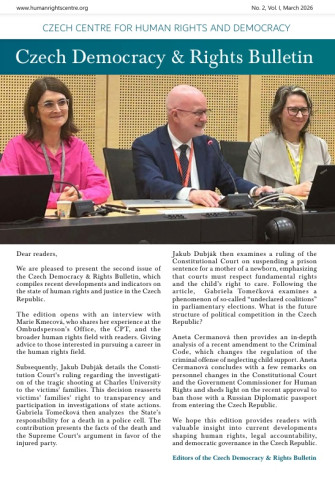
We are pleased to present the second issue of the Czech Democracy & Rights Bulletin, which compiles recent developments and indicators on the state of human rights and justice in the Czech Republic.
The edition opens with an interview with Marie Kmecová, who shares her experience at the Ombudsperson’s Office, the CPT, and the broader human rights field with readers. Giving advice to those interested in pursuing a career in the human rights field.
Subsequently, Jakub Dubják details the Constitution Court's ruling regarding the investigation of the tragic shooting at Charles University to the victims' families. This decision reasserts victims' families' right to transparency and participation in investigations of state actions. Gabriela Tomečková then analyzes the State’s responsibility for a death in a police cell. The contribution presents the facts of the death and the Supreme Court's argument in favor of the injured party.
Jakub Dubják then examines a ruling of the Constitutional Court on suspending a prison sentence for a mother of a newborn, emphasizing that courts must respect fundamental rights and the child’s right to care. Following the article, Gabriela Tomečková examines a phenomenon of so-called “undeclared coalitions” in parliamentary elections. What is the future structure of political competition in the Czech Republic?
Aneta Cermanová then provides an in-depth analysis of a recent amendment to the Criminal Code, which changes the regulation of the criminal offense of neglecting child support. Aneta Cermanová concludes with a few remarks on personnel changes in the Constitutional Court and the Government Commissioner for Human Rights and sheds light on the recent approval to ban those with a Russian Diplomatic passport from entering the Czech Republic.
We are pleased to present the third issue of the Czech Democracy & Rights Bulletin, which compiles recent developments and indicators on the state of human rights and justice in the Czech Republic.
The edition opens with the most recent development in the ongoing dispute of judges' pay, as the Constitutional Court strikes down a temporary law that would decrease judges' salaries by 6%. This decision illustrates the ongoing tension between the legislature, which seeks to cut costs, and the judiciary, which argues that salary protection is essential to judicial independence.
Gabriela Grünová then examines the human rights dimension of climate protection by analyzing the Constitutional Court's ruling against an environmental association and several individual farmers. The farmers and environmental association argued that the ministries have been violating their constitutional rights to a favorable environment. By commenting on the Court's decision not to hold the ministry accountable, Grünová asks the question, " Is legislative action the best way of protecting our climate.
Subsequently, Jonáš Hodaň details the public's reaction to the rejection of Filip Turek’s nomination for the post of Minister of the Environment. Detailing critiques and concerns surrounding what the presidential power should be regarding rejecting nominations for government.
In addition, Ondřej Kučera then provides an in-depth analysis of the ongoing ramifications of the COVID-19 pandemic, specifically regarding government measures. Kučera draws on a recent case surrounding a retail company seeking payment for lost profits and how the ruling closed a series of lawsuits that have been dragging on since the pandemic.
Finally, Gabriela Grünová provides updates on Czech news, including articles on conflicts of interest between government officials and companies, the Constitutional Court's disciplinary action regarding AI use, and the Constitutional Court's ruling on Involuntary hospitalization.
We hope this edition provides readers with valuable insight into current developments shaping human rights, governmental accountability, and powers.