
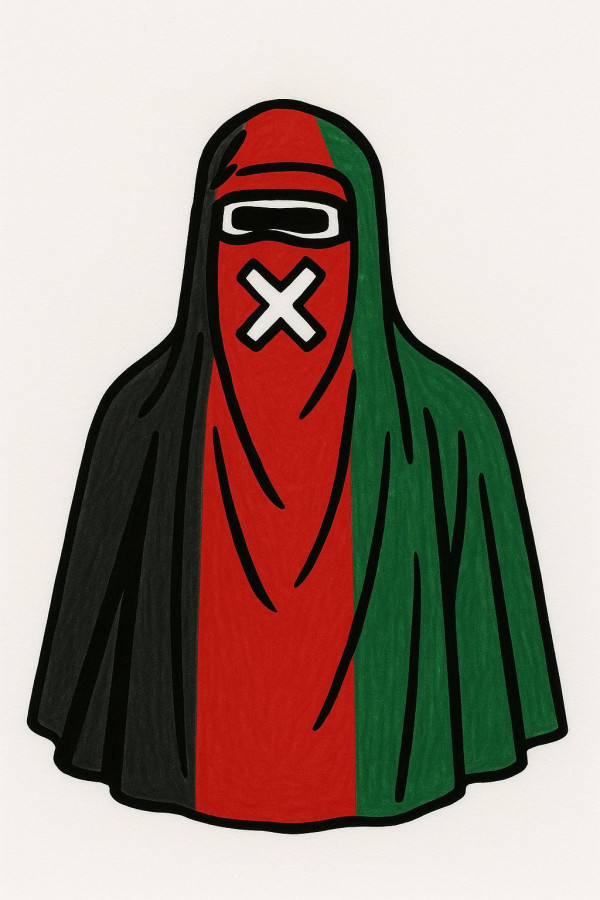
Portugal and Italy are currently moving forward with a new bill that would ban people from covering their faces in public spaces. Both these proposals clearly follow the famous “French model” from 2010. While the bills include many exceptions, it raises important questions about how Europe balances such bans with religious freedom.
The debate in Europe about what people can wear in public is growing since the beginning of the 21st century, mainly because of the ongoing migration crisis. Many states are trying to decide if especially religious clothing or symbols should be allowed in public life.[1] Portugal and Italy are (for now) the latest states to join this conversation. A new bill is moving through both their parliaments, and it looks very much like the law we have seen in France.
The French Precedent
France was the first European state to adopt a complete ban on covering the face in public in 2010 (with some exceptions, e.g. for health or professional reasons). The adoption of the law followed a report by the French National Assembly (Assemblée nationale), which concluded that wearing such clothing constitutes contempt for the republic, which is unacceptable.
The French law was first, prior to its adoption, found to be constitutionally compliant by the French Constitutional Council (Conseil constitutionnel). Later on the French law was also brought before the European Court of Human Rights (ECHR), which dismissed the complaint of a Muslim woman in the case of S.A.S. v France.
The complainant stated that she wore a burqa and niqab in accordance with her faith, culture and personal beliefs, which was made impossible by the French law. The ECHR acknowledged that the law constitutes a continuing interference (ingérence permanente) with the rights protected by Articles 8 and 9 of the European convention on human rights (the Convention).
Given the scope of the defendant state’s margin of appreciation, the ECHR concluded that the ban was proportionate to the aims pursued, namely the preservation of the conditions of “living together” (vivre ensemble) as part of the protection of the rights and freedoms of others. It therefore assessed the ban as necessary in a democratic society within the meaning of the Convention.
However, the UN Human Rights Committee disagreed after and found the French law discriminatory against Muslim women. Even though it acknowledged that, in certain situations, it may be necessary for the state to require individuals not to cover their faces (e.g., for identification purposes).
Nevertheless, the UN Human Rights Committee found that the French law was not limited to such situations but completely prohibited the wearing of certain items of clothing in public at all times. Even so, France has not changed its rules.[2] The different approach is mainly due to the fact that the UN Human Rights Committee (unlike the ECHR) does not apply the doctrine of margin of appreciation.
The Portuguese Context
In Portugal, a new bill from the Chega party (far-right) is currently making its way through the parliament. The proposal says that no one should cover their face in public, and no one can force someone else to do so.
The explanatory memorandum refers to the secular character of the state and to article 27 of the Portuguese constitution which guarantees a “right to security”. It draws inspiration mainly from the French legislation and case-law of the ECHR following on from this legislation, but also from other European states’ legislation.
However, the bill lists numerous exceptions to the ban. The face may be covered for health, professional, or artistic reasons. Faces may also be covered in places of worship and other sacred places, or due to climatic conditions.
In case of a violation, the bill stipulates a fine of 200 euro to 2.000 euro for negligence and 400 euro to 4.000 euro for intentional acts.
On 17th of October 2025 the parliament approved the bill in general terms. The bill is now being studied by a Special Committee on Constitutional Affairs. If they approve it, the parliament will vote on it one last time before the President's signature. However, instead of signing, President could veto the bill or send it to the Constitutional Court for checks.
Italy is Going in the Same Direction as Portugal
Apart from Portugal, Italy is also moving forward with a similar bill. In August 2025, Italy’s ruling party Brothers of Italy (Fratelli d’Italia) introduced a bill against “Islamic separatism”.[3] As in Portugal, the bill is currently under review by a Special Committee on Constitutional Affairs.
However, the Italian bill has wider range than the Portuguese bill. Apart from banning face coverings which “makes it difficult to recognise a person” in public places or places open to public, including commercial establishments or educational institutions, without prejudice to “legal obligations”, the bill targets other areas as well.
It deals with financing for construction of places of worship and religious facilities, including financing from foreign states. The Italian bill also combats forced marriages and propaganda for reason of religious hatred and enables the possibility of a temporary closure of places of worship.
Wider European Trends
Portuguese and Italian initiatives are part of a bigger trend. France’s ban was followed, for example, by Belgium, Netherlands, Bulgaria, or Austria. The most recent state to join this trend is Switzerland since January 2025.
On the other hand there were already two efforts in 2012 and 2013 in the United Kingdom for regulation of face covering and they came out unsuccessfully. During the second reading, the bill did not pass because the former Prime Minister David Cameron ended the parliamentary session early and the bill was not discussed in subsequent meetings. However, it is unlikely that the bill would have been passed, as many MPs expressed their disagreement with the ban during parliamentary debates and indicated that they would vote against the bill.
Furthermore, in October 2025, Sweden‘s Deputy Prime Minister has called for her country to completely ban the burqa in public. However, at the moment, there was no bill introduced yet.
Possible Future Developments?
The situation in Portugal and Italy confirms that the “French model” of banning face coverings remains a relevant factor for European legislation even more than 15 years later after its adoption. It is therefore possible that similar bans will try to succeed in other European states.
While the ECHR has deemed these bills to be compliant with the protection of the “living together” right, the criticism from the UN Human Rights Committee shows that the legal debate is still very much alive. If the Portuguese or Italian bans were to be challenged, this could prompt the ECHR to develop its existing case law. This could involve a more rigorous scrutiny of the “living together” justification, or even a partial departure from ECHR’s previous stance, reflecting a shift in how the ECHR balances such measures with individual religious freedom.
As the Portuguese and Italian bills make their way through local parliaments, it serves as a reminder of the ongoing tensions between individual religious freedom and secular character of the state. Whether this trend will continue to spread to other states or face more successful opposition, like in the United Kingdom, remains to be seen. For example, in the Czech Republic there isn’t at the moment legal basis for such bans, as the Czech Supreme Court confirmed in a case concerning Somalian national who wore hijab[4] in school.
Conclusion
Given all of the above, it is almost certain that the Italian and Portuguese initiatives are not just isolated “experiments”. Rather, they confirm a deeper European trend, suggesting that we have not seen the last of such legislative efforts. It is also fascinating to see how a fifteen-year-old French idea has returned to the scene with such intensity, still serving as an inspiration for states even in 2026.
Although the ECHR has so far upheld these bans under the umbrella of “living together”, the criticism from the UN Human Rights Committee reminds us that this path is not without flaws and is far from settled. If these new laws are challenged, the ECHR may have to reexamine its previous rulings and perhaps even start moving in a different direction.
Ultimately, the question remains: Do these bans truly bring people closer together or do they only deepen the lines between them? Whatever the final outcome in Portugal or Italy, one thing seems certain - the debate on what people may or may not wear in public is far from over.
Notes
[1] Primarily concerning religious veils, such as the niqab or burqa. The niqab is a veil for the face that leaves the area around the eyes clear. The burqa is a one-piece veil that covers the face and body, often leaving just a mesh screen to see through.
[2] This is mainly because the Committee’s decisions (constatations) do not carry the legal authority of a binding judgment (in contrast to, for example, ECHR’s judgments).
[3] Here, one can see clear inspiration from French legislation. In 2021, France adopted the so-called “loi séparatisme” with the goal to fight “radical Islam”. See French act of August 24, 2021, strengthening respect for the principles of the Republic, the so-called “loi séparatisme“. Available at: https://www.legifrance.gouv.fr/jorf/id/JORFTEXT000043964778.
[4] The hijab is a veil that covers hair and neck but leaves the face area visible.
Sources
Portuguese bill no. 47/XVI/1, which prohibits the covering of the face in public spaces, with certain exceptions. Available at: https://www.parlamento.pt/ActividadeParlamentar/Paginas/DetalheIniciativa.aspx?BID=315166. Translated using a translator.
Italian bill C. 2562, which amends the Criminal Code and other provisions concerning the fight against religious fundamentalism. Available at: https://www.camera.it/leg19/126?leg=19&idDocumento=2562. Translated using a translator.
French act of October 11, 2010, prohibiting face covering in public spaces. Available at: https://www.legifrance.gouv.fr/jorf/id/JORFTEXT000022911670.
French act of August 24, 2021, strengthening respect for the principles of the Republic, the so-called “loi séparatisme“. Available at: https://www.legifrance.gouv.fr/jorf/id/JORFTEXT000043964778.
Belgian act of June 1, 2011, prohibiting any clothing that completely or largely covers the face. Available at: https://refli.be/fr/lex/2011000424.
Dutch act of August 1, 2019, on the partial ban on face covering. Available at: https://wetten.overheid.nl/BWBR0041161/2019-08-01. Translated using a translator.
Bulgarian act prohibiting the wearing of clothing that covers or conceals the face. Available at: https://www.parliament.bg/bg/laws/ID/42106. Translated using a translator.
Swiss federal act of September 29, 2023, prohibiting face coverings. Available at: https://www.fedlex.admin.ch/eli/cc/2024/620/fr.
Austrian act of June 8, 2017, against face covering. Available at: https://www.ris.bka.gv.at/GeltendeFassung.wxe?Abfrage=Bundesnormen&Gesetzesnummer=20009892.
British Face Coverings (Regulation) Bill. Available at: https://bills.parliament.uk/bills/701.
British Face Coverings (Prohibition) Bill. Available at: https://bills.parliament.uk/bills/1221.
European Court of Human Rights (July 1, 2014). Judgment of European Court of Human Rights in S.A.S. v. France. Available at: https://hudoc.echr.coe.int/eng#{%22itemid%22:[%22001-145466%22]}.
UN Human Rights Committee (July 17, 2018). Decision of UN Human Rights Committee in Sonia Yaker v. France. Available at: https://juris.ohchr.org/casedetails/2547/en-US.
Czech Supreme Court (June 17, 2021). Judgment of the Supreme Court file no. 25 Cdo 348/2019. Available at: https://www.nsoud.cz/en/summaries-of-decisions/detail?tx_news_pi1%5Ba3.
SkyNews (October 18, 2025). Portugal set for burka ban after MPs back right-wing party‘s plan. Available at: https://news.sky.com/story/portugal-set-for-burka-ban-after-mps-back-right-wing-partys-plan-13452199.
Assemblée nationale (January 26, 2010). Information report prepared on behalf of the fact-finding mission on the practice of wearing full-face veils on national territory. Available at: https://www.assemblee-nationale.fr/13/pdf/rap-info/i2262.pdf.
Conseil constitutionnel (October 7, 2010). Decision of the French Constitutional Council, file no. 2010-613 DC. Available at: https://www.conseil-constitutionnel.fr/decision/2010/2010613DC.htm.
Saunders, James (October 14, 2025). . ‘The burka does NOT belong in Sweden - ban it while we can,’ warns Deputy PM. GB News. Available at: https://www.gbnews.com/news/world/sweden-burka-ban-ebba-busch-islam.
Jochecová, Ketrin; Giordano, Elena (October 8, 2025). . Italy wants to ban Islamic face coverings, mosque funding. Politico. Available at: https://www.politico.eu/article/italy-religion-hijab-mosque-muslims-islam-ban-politics-bill/.
Paggi, Leo Valerio (January 28, 2026). Separatismo religioso, Fratelli d’Italia alza il livello: sicurezza, trasparenza e difesa dei valori costituzionali. La Voce del Patriota. Available at: https://www.lavocedelpatriota.it/separatismo-religioso-fratelli-ditalia-alza-il-livello-sicurezza-trasparenza-e-difesa-dei-valori-costituzionali/. Translated using a translator.
Open Society Justice Initiative (2022). Restrictions on Muslim Women's Dress in the 27 EU Member States and the United Kingdom. Available at: https://www.justiceinitiative.org/publications/restrictions-on-muslim-women-s-dress-in-the-27-eu-member-states-and-the-united-kingdom.
Photographs
[1] The ban is currently making its way through the Portugal’s parliament. Útlak afghánských žen, author: generated using ChatGPT 5 based on a template by Barbora Bulánková, August 28, 2025.